
Aaron Swartz was arguably the very first ‘hacktivist’, someone who would use their knowledge of hacking and computers in order to promote political or social change. Swartz perfectly embodies the hacktivist persona in that he believed wholeheartedly in the greater good. Swartz believed in the freedom of information and that the current collegiate system of locking away papers behind a pay wall is immoral and unjustified.

Swartz released thousands of academic papers online and as such was indicted in Federal District Court on four felony counts: wire fraud, computer fraud, unlawfully obtaining information from a protected computer and recklessly damaging a protected computer. Swartz was continually pressured by the FBI and the United States government and felt more and more threatened by these parties that he eventually hanged himself.
This was the most tragic and sad of all the documentaries I watched as a part of this module and as such had a profound effect on me as a viewer of the documentary. Aaron Swartz was a gifted young man who had accomplished more in his short life than most ever do. In the documentary we are introduced to his family and close friends as well as colleagues who admired and respected him. This created a sense of knowing with me as I watched the first half of the documentary where we are introduced to Swartz and added to the sad tone of the documentary when it is revealed that Swartz committed suicide as we can see the devastation in the eyes of his friends, family members and colleagues as they recount their feelings of loss. Also contributing to the personal feeling of the documentary was the old home video footage and pictures of Swartz as a child.
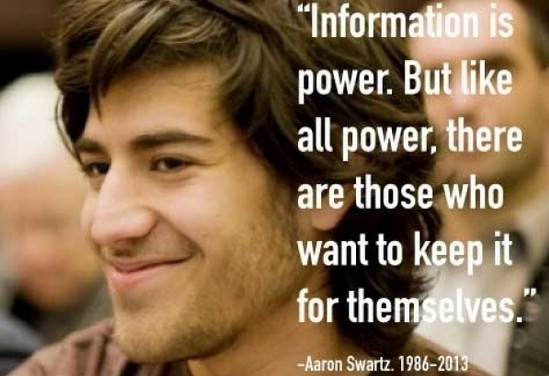
Many who would watch this documentary would be familiar with Swartz professional work life but few would have an insight into the person he was in his private life. This documentary helped to humanise him and subsequently helped me to identify with Swartz and realise the injustice committed in the way he was treated. Swartz was used as an example to future hacktivists and as such his sentence was far harsher than his crimes deserved.
The issues that I found interesting that were dealt with in this documentary were the flaws of the American legal system. The abuse of power demonstrated by the United States government in this documentary against someone with good intentions was harrowing. The fact that there are people in positions of power that are content with ruining the lives of someone like Aaron Swartz shows clearly that justice in places like America needs to be reevaluated so that people who want to help others are not shunned and driven to suicide by those in positions of power that value making money over human lives.
Swartz questioned why information should be restricted to those who can afford it and suggested that information would benefit humanity as a whole were it freely available to anyone and paid for asking these questions with his life. It is because of him that the internet is the way it is today and it is our collective responsibility to honour his memory by fighting for civil and educational liberty today.
REFERENCES
- The Internet’s Own Boy: The Story of Aaron Swartz. Directed by Brian Knappenberger, Luminant Media and Unjustsus Films, 27 Jun 2014.
 Oscar's Blog